
If you’re planning a visit to Peru, chances are you’ve heard of the Inca Trail. However, the hike whose name you often hear echoing through bars and hostels when you get into the country isn’t this classic trek. No: those in the know are talking about the Huayhuash Circuit.
With strict limits on permits and spiralling costs, the Inca Trail is not the easiest trek to get onto, and if you are seeking pure, sublime nature, it might not even be your best option.
That’s where the Huayhuash Circuit comes in. It offers an eight-day romp through Peru’s most dramatic section of the Andes, with each day including a climb to a mountain pass, with vistas of turquoise mountain lakes and condors wheeling overhead. You cannot fail to be struck by the beauty of the Huayhuash Mountains.
This guide will offer a day-by-day breakdown of the trek and offer key advice for packing and booking the hike.
Key facts about the Huyahuash Circuit
The eight-day Huyhuash Trek
Day one
My Huayhuash Trek experience began with a 2:30am pick up by the tour operator, followed by breakfast at the village of Chiquian at 7am. A further hour-long drive along winding Andean roads brought us to the trailhead. Some companies will offer a 9am start and will drive you straight to the first campsite, meaning that you skip the first day of walking.

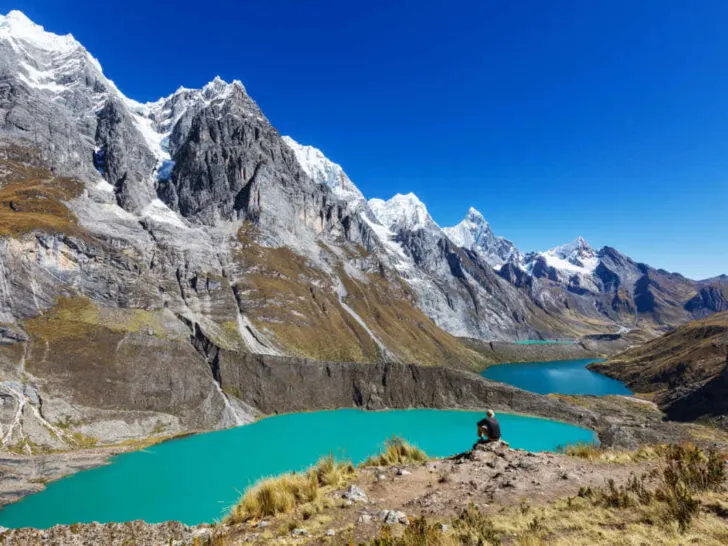
The first day’s walk was a nice little foretaste of what was to come. The first couple of hours follow a gently sloping path, leaving the road, and civilisation, out of sight. The climb up to the pass was a 500m (1640ft) ascent, giving us views of the frost-crowned Cordillera Huayhuash in the distance. Overhead, condors wheeled in pairs.
Having descended from the pass, we ate lunch beside a stream – two courses of delicious quinoa soup and chicken with rice. The flat path to camp felt more like Scotland than Peru – sodden dun landscapes crossed by babbling brooks.
We arrived at camp by 3pm for some well-deserved naps and rest. Like the other campsites, this included flushing toilets but no showers or toilet paper. It faced the soaring peaks that we would be amongst for the next few days.
Day two
This day set the timetable for the hike: a 6am wake-up for breakfast and a 7am walking start. The first stage of this walk was much like the first day – vast silent valleys and undulating, steely grey ridges.
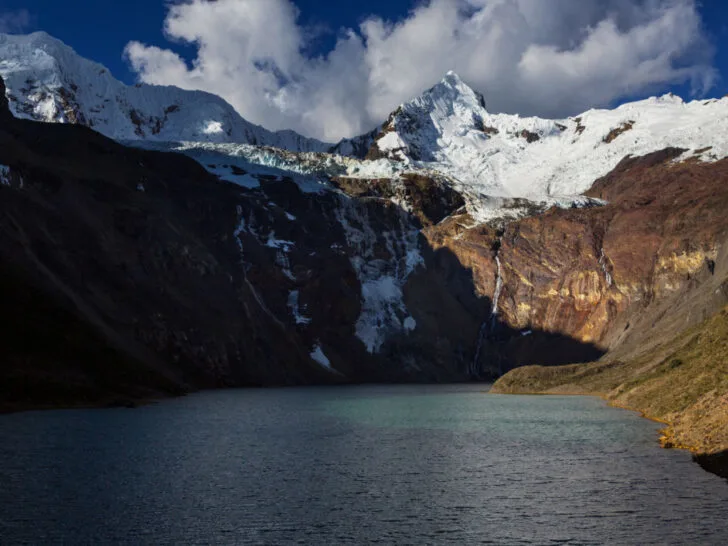
We spent an hour at the Cocananpunta Pass admiring the views; perched on a ridge, we were parallel with the shining ice sheets of Peru’s second-highest mountain, Yerupaja, while below, two of the pristine Tres Lagunas lakes glowed topaz in the dappled sunlight.
A steep descent followed to reach camp at Lake Carhuacocha. This was my favourite campsite. It was a joy to contemplate the views of the mountains and the lake while sunbathing and playing cards for the afternoon.
Day three
I had eagerly anticipated this day, with views of the Tres Lagunas in store. Unfortunately for me, I opened my tent to driving rain and minimal visibility. As I walked, I fretted about losing my chance to see that view I had been dreaming about since I booked my flight to Peru. However, the more I walked, the more the eerie mists added a new dimension to the vistas which I greeted with scarcely suppressed gasps of wonder.

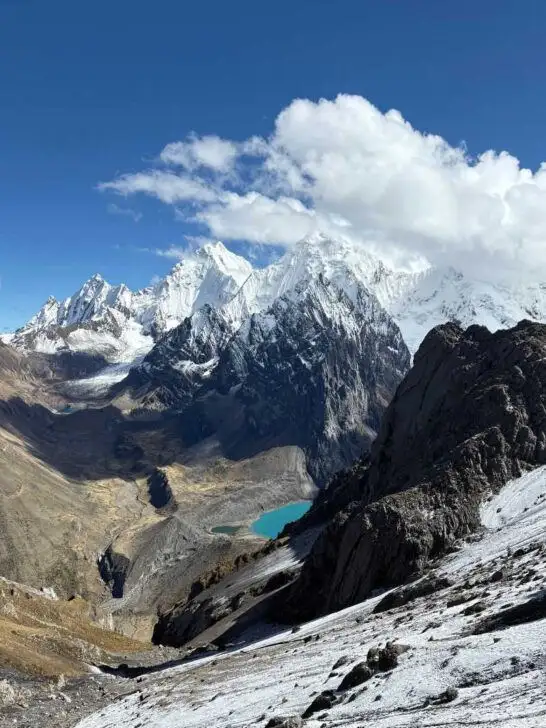
With mist rolling off the mountain sides and the valleys darkened by the clouds overhead, the sapphiric lakes glowed even more. This view will look good in any weather conditions!
The walk up to the pass was difficult. I was now soaked to the skin, and we were greeted with a blizzard in the mountain pass. Reaching the pass at 4800m (15,748ft) brought a real sense of achievement, and seeing the sun break through the clouds on the walk down to camp made everyone hum with energy after being bullied by the elements for hours!
We dried out at camp, and some even braved the glacial streams for a shower.
Day four
We began walking under a blazing sun and vaulting mountains. Underfoot were what looked like 3D lily pads, but were actually colonies of algae that somehow combined to become harder than concrete, making it feel like we were walking through another world.
Though there were some steep sections, the path gradually climbed to the highest point of the trek. We were eye level with ice sheets and could hear the goosebump-inducing groans of the ice. The pass is a hundred metres (328ft) below Everest Base Camp.
The descent brought a new type of beauty: the Cordilliera Huayhuash’s answers to Rainbow Mountain was the background, surrounded by lakes of varying shades of azure. The highlight was a vast lake with the same deep blue colour palette as Laguna 69, a popular lake near Huaraz.
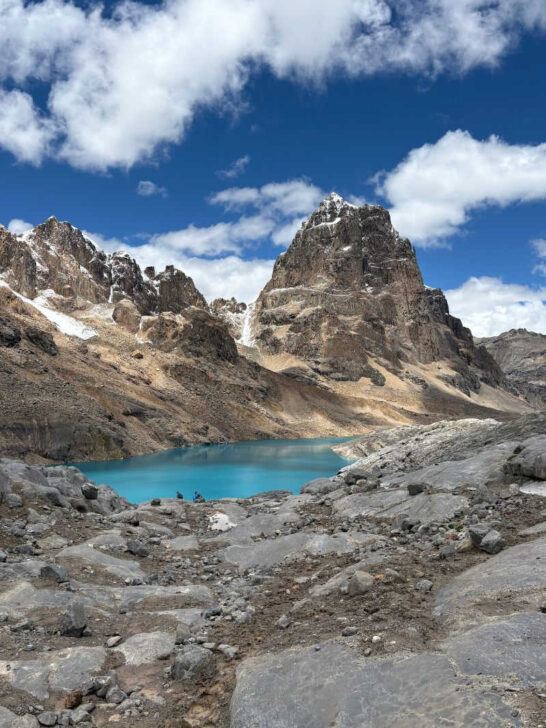
The campsite was nicknamed Camp Elephant for a rock formation looking like a sleeping elephant and had streams nearby – a ready-made ice bath for tired legs.
Day five
The day opened with a challenge: a brutally steep ascent up to 5000m (16,404ft) through slippery mud. However, the viewpoint was well worth the uphill slog. Ahead loomed basalt black mountains, frosted with eternal winter, while at the base was a radiant turquoise lake.
The rest of the hike was less challenging. The trail dropped a kilometer of altitude, routing alongside waterfalls and banks of lupins, before finally passing farms, as we reached 3500m (11,482ft) above sea level.
At Huayllapa village, we had the option of a bed and a warm shower, which naturally everyone jumped at. The village itself is a strange medley of two worlds, between Quechua-speaking poncho-clad traditional Peru and tourist shops selling fake Patagonia and North Face. Anyhow, it was a wonderful place to sleep in a proper bed and drink some well-deserved cervezas. It was also the place where we bade farewell to more than half of the group who undertook the five-day route, which terminates here.
Day six
This was the big one. We paid for our descent with a gruelling 1200m (3937ft) climb back into the high Andes. The change in the vegetation was incredible: the greenery of the landscapes became bleached, and the creatures fewer as we climbed in height.
The centrepiece was a glaciated peak above a shimmering lake – however, it ranked as the worst ratio of effort to natural beauty on the hike. I even found myself regretting not following many of my companions back to Huaraz after five days.

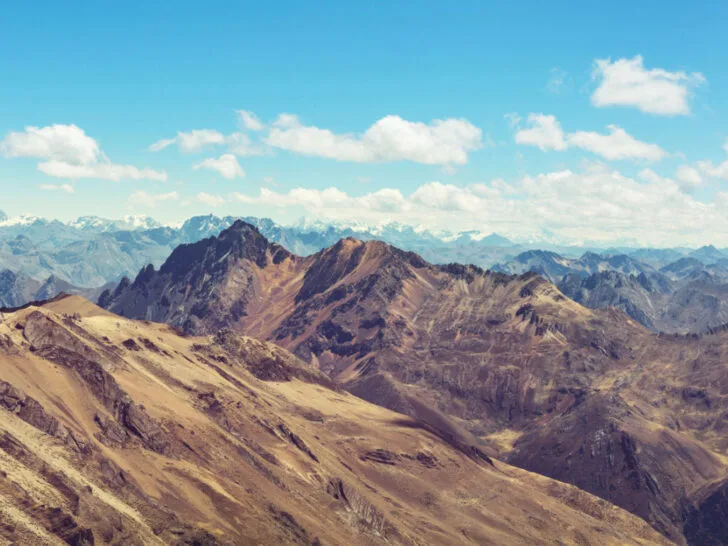
The descent was short. Just a 300m (984ft) drop to our camp at 4500m (14,763ft). This was the coldest of the hike, although I was too tired to feel anything. I slumped into my sleeping bag immediately upon reaching camp for a three-hour nap, followed by a ten-hour sleep.
Day seven
I awoke with little feeling in my fingers and toes and icicles in my moustache. Pulling the tent flap open, I was dusted with snow.
If the day before I had rued not exiting early, and was frustrated by a ratio of views to effort, today more than reversed any negativity. With just 300m (984ft) of gradual climbing and personally, my favourite views of the trip, day seven more than made up for my previous exertions and vindicated my decision to walk the classic circuit.
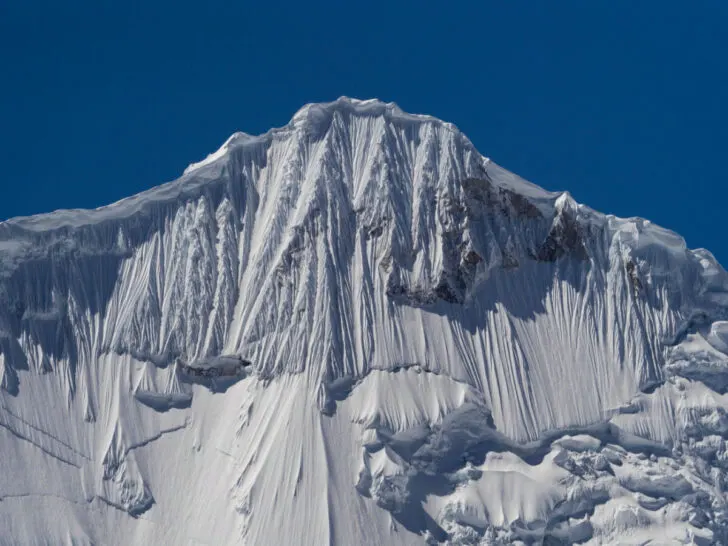
There is nothing quite like the views of ridge after ridge of snow-capped peaks falling away into the distance on all sides. Yerupaja, Peru’s second-highest mountain, was the diamond in this bejewelled crown.
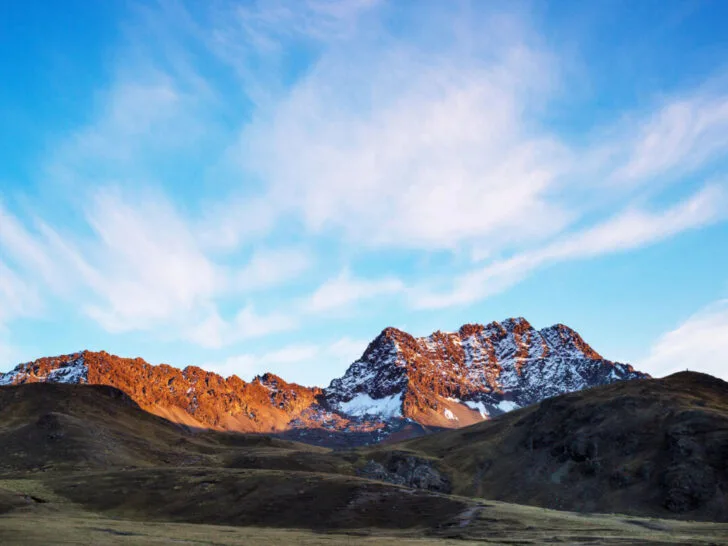
The walk down was exceptionally steep, but the final camp was a worthy reward. The tents were pitched on the shore of a great lake, with triangular peaks in the distance, but, most importantly, beside a local community with crates of cold beer. Sipping that beer against that backdrop with that sense of triumph made it maybe the tastiest of my life.
Day eight
To avoid a coming storm, a 4am wake-up was imposed. The path to Popca and the waiting van was either flat or downhill and took four hours, and I arrived back in Huaraz at 3pm.

What to pack to hike the Huyahuash Trek
- Day pack – Your duffel bag will be transported by mules but you will need to carry a daypack big enough for snacks, water, your camera, and other things that you will need while walking. We recommend Osprey (men/women).
- Hiking poles – My tour agency provided these, but this is not standard across the board. These are necessary, or the Huayhuash Circuit will buckle your knees. (REI/Amazon).
- Hiking boots – Proper hiking boots are a real necessity on this route. Without good ankle support, you may injure yourself. They also must be broken in (worn a couple of time to loosen up the boot), or you will likely suffer from blisters. We recommend Salomon boots (men/women).
- Thick socks – These are needed to prevent blisters, and also to keep your toes warm at night. I would recommend bringing extra pairs, as you run the risk of getting wet on this trek. We recommend Darn Tough for both liner (men/women) and outer socks (men/women).
- Sandals or sliders – These are brilliant for relaxing at camp after a long day’s walking and letting your feet breathe. Teva sandals are versatile and known to last (men/women).
- Warm clothes – This is a cold-weather hike, and you will need a very warm down jacket (men/women) for comfort, particularly for nighttime at camp. I would also recommend bringing thermal base layers to help you layer up and layer down. Under Armour do some great thermal layers (men/women).
- Hiking trousers – Bring a couple of pairs of comfortable hiking trousers. Convertible pants are a great option (men/women).
- Headlamp – A headlamp makes life in camp so much easier.
- Battery pack – You will be without electricity for five days until you reach Huayllapa, so bring a battery pack to charge your devices.
- Camera – When you are witnessing views this good, you will want to capture them properly. I brought a 35mm film camera, and I cannot wait to develop the snaps. If you know you’re going to want to take lots of photos, make sure to pack spare rolls of film.
- Sunhat and suncream – While this is a cold hike, the high UV exposure of the sun at altitude will fry you if you are not careful. Bring suncream and constantly reapply it.

- Sunglasses – The reflection of sunlight on glaciers and lakes can burn your eyes. Bring sunglasses to enjoy the views safely.
- Dry bags – These enable you to protect your clothes from damp during transit and are helpful in separating dirty and clean clothes. We recommend Sea to Summit (Amazon).
- Wet wipes – There are no showers on this trek, and it is often too wet and cold to hazard a dip in a mountain stream. Your best bet is to have a wet wipe shower.
- Tissues and toilet paper – There are flushing toilets, but no toilet paper. Your nose will also most likely be running from the climate, so bring paper to catch drips of all kinds.
- Snacks – My collection of chocolate bars, mentos, and chewing gum helped me to power through the hike.
- Cash – Some operators do not include the national park entry fee of 240 soles, which must be paid in cash. There are also a handful of opportunities to buy drinks or snacks on the way, and trust me, you will be craving a beer or Coca-Cola after a few days on the trail. Bring cash to tip your guide, too.
- Camping gear, including tents, sleeping bags, and sleeping mats, are included as standard by all of the tour operators I inquired with.
Travelling solo or with a guide
In the bars of Huaraz, you will often hear someone proudly boasting of completing Cordillera Huayhuash all by themselves. Does this mean that you, too, should undertake this challenge? I would think very carefully about it.
While it is possible to complete the Huayhuash Circuit without a guide, this is a Herculean feat of endurance. When carrying your tent and four-season sleeping bag, you are making the climb orders of magnitude harder. Walking for days at altitude is gruelling even without a massive bag strapped to you.
Hiking alone also means you run the risk of being alone should an accident happen or you have an issue with your tent or cooking equipment. In short, it is possible to walk Cordillera Huayhuash solo, but you should only do this with extensive hiking experience and extreme fitness.

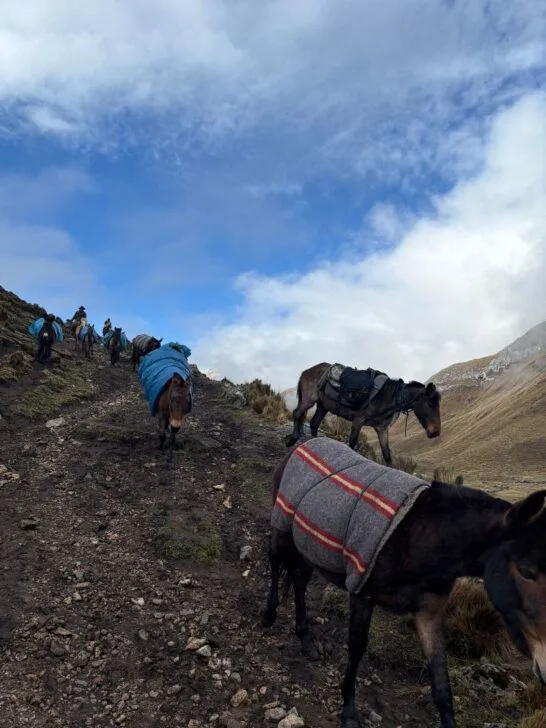
For everyone else, a guide is your best bet. Fortunately, there are scores of operators in Huaraz offering experienced guides and teams, including cooks and muleteers, allowing you to stroll into camp with your tent all set up and a hot meal waiting. When I travel, I always seek to find agencies that include the local people in the riches of tourism.
This is doubly important in Ancash, Peru, a very rural area, where the Indigenous population has rarely benefited from the economic gains of tourism.
I booked with Huayhuash Adventures, who provided a local English-speaking guide, William, who wore a perpetual smile on his face and his companions, who likewise hailed from rural communities.
It felt very meaningful to learn about the landscapes with someone whose ancestors had trodden these paths for millennia. He also taught me some Quechua phrases as we walked.
When’s the best time to hike the Huyhuash Circuit?
The best time to hike Cordillera Huayhuash is during the dry season, May to September. The best two months are July and August, which have the lowest chance of rain and so the best visibility. Expect crystalline skies, no rain, and perfect stars at night during these two months.
I hiked the Huayhuash Circuit in the first week of October, firmly outside of the ideal period, but the weather wasn’t poor enough to put people off. It rained every day, but most often in the afternoon when we had finished walking for the day. I only had one day of actually walking in the rain, and three days of perfect sunshine.
It is not recommended to undertake the hike in the rainy season, December to February, when the intensity of the rains is such that the paths can collapse and become dangerous.
Outside of this, it depends on your appetite for being soaked. Tours are available year-round.
What does it cost?
To complete the eight-day Huayhuash trek independently, expect to pay in the region of $260-330 USD. This includes transport from Huaraz to Llamac and back from Pocpa, plus community and camping fees, gear rental, fuel and food and $20 USD of miscellaneous costs like expenses on snacks on the trail. This falls to $190 USD for the five-day circuit.

For a guided eight-day tour, I paid $560 USD, including the 240 soles national park entry fee ($70 USD). It’s possible to take a cheaper tour – I found one for $520 USD – however, I was not convinced that it was the best option, as the national park entry fee was not included and the operator did not have many reviews.
The cost of tours includes gear rental such as sleeping bags, sleeping mats, and tents, as well as all meals and snacks, plus an experienced guide and a team of muleteers who carry up to a five-kilo duffel bag for each hiker. Five-day tours start from $450 USD.
On the trail, it is advisable to carry cash. There are many opportunities to buy snacks or drinks from local communities. It is also standard to tip your guide in the region of 50 soles.
Some companies also do not include the national park entry fee in the cost, which must be paid in cash. There are no ATMs on the trail, and in a region without electricity, there is no chance of card payments either, so withdraw cash in Huaraz before you leave.
I carried 300 soles with me, but only spent 100. There are several ATMs in Huaraz; I would recommend Banco de La Nación, which does not charge withdrawal fees.
In terms of gear rental, it is standard for operators to include heavy, specialist gear like tents, sleeping bags, and mats. However, most do not include hiking poles, which are heavily recommended on this knee-buckling trek. If you do not have a waterproof jacket, this absolutely must be bought or rented from one of the many outdoor shops in Huaraz before you set off.
If you have moderate levels of fitness and a desire to see the Andes at their wildest, the Cordillera Huayhuash needs to be on your Peru itinerary. The sense of triumph that comes from reaching the minivan after eight days in the wild makes all the tiredness and cold worth it.
If you’re completing the Cordillera Huayhuash Trek as part of a larger Peru trip, make sure to read through our other Peru travel guides. Discover our top Peru itineraries, our must-try Peruvian culinary recommendations, and our favorite hotels throughout Peru – or delve deeper into our complete guide to visiting Machu Picchu here.